
For Christians Considering the “No Kings” Protest
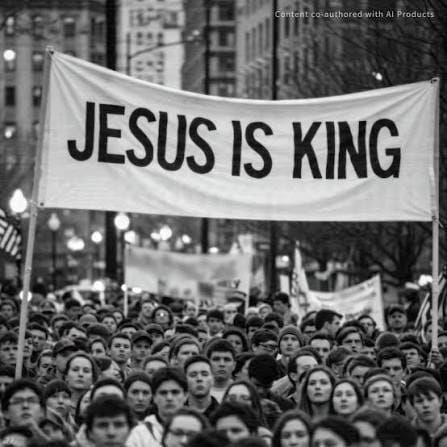
If you’re weighing whether to join the “No Kings” protest this weekend, that’s a good sign. The fact that you’re wrestling means you care about both truth and witness. You don’t want to be silent in the face of corruption, but you also don’t want to be swept into a movement where the loudest voices don’t reflect Christ. That tension isn’t weakness—it’s wisdom.
The question isn’t only should we protest? It’s how do we bear witness to the Kingship of Jesus when earthly powers misrepresent Him?
We live in an age when politicians routinely borrow the language of faith to baptize ambition. Some call themselves defenders of Christian values while mocking integrity, excusing cruelty, or dismissing justice for the poor. They trade humility for dominance, repentance for rhetoric. And too many Christians have fallen under the spell of this performance, mistaking power for blessing and charisma for anointing.
That’s not new. Scripture gives us a long list of leaders who did the same.
Moses stood before Pharaoh—a ruler who built an empire on exploitation and called it prosperity. Pharaoh refused repentance even when confronted by truth. His arrogance became his undoing.
Nathan stood before David, not to destroy him but to expose him. David had used his power to take what wasn’t his and then justified it as privilege. Nathan’s confrontation was a reminder that no leader, however chosen, stands above correction.
Esther walked into the throne room of a king who governed by ego and decree. She risked her life to speak for those who had no voice. Her courage teaches us that silence in the face of injustice is not neutrality—it’s surrender.
And John the Baptist—he didn’t lose his life because he meddled in politics. He lost it for speaking truth to a ruler who wore religion like a costume. Herod invoked faith to court the faithful while living in open defiance of God’s law. He used sacred language to fortify a corrupt throne, twisting belief into branding. John called it what it was—and paid for it with his head.
The apostles faced Rome with the same defiance—not the defiance of rage, but of allegiance. Rome promised peace through control, order through fear. The apostles declared another King and another kingdom. Their confession—“Jesus is Lord”—wasn’t private devotion. It was public dissent against the idolatry of power.
This pattern runs through Scripture. When rulers claim God’s name but deny His ways, the people of God must speak. When leaders use faith as a prop for immorality or greed, silence becomes complicity. Protest, for believers, isn’t rebellion—it’s repentance. It’s the act of saying: We will not bless what God condemns, nor remain quiet while power mocks holiness.
So as you discern whether to protest this weekend, remember: our allegiance isn’t to a movement, a party, or a personality. Our allegiance is to a crucified King. His throne is not gilded with influence or flattery—it’s stained with sacrifice. His crown was made of thorns, not gold. His followers can’t seek His kingdom through the methods of empire.
Practical Guidance for Those Who Participate
Pray Before You Go
- Begin in prayer, not reaction. Ask the Spirit for discernment, courage, and peace.
- Invite God to search your motives: Are you there to prove a point or bear witness to a King?
- Pray for those who will attend on both sides—protesters, police, counter-protesters, and bystanders.
Go Together, Not Alone
- Bring two or three trusted believers who share your purpose and tone.
- Agree in advance that your posture will be peaceful and prayerful, no matter what unfolds.
- Stay aware of one another; keep safety and accountability central.
Carry What You Need, Leave What You Don’t
- Bring water, a small snack, your ID, and a charged phone.
- Keep your sign simple and truthful. “Jesus is King—and He doesn’t share His throne” speaks volumes on its own.
- Leave valuables, distractions, and anything that could be misread as aggressive at home.
Let Your Presence Speak More Than Your Volume
- Keep your body language calm, open, and approachable.
- If someone shouts, don’t match tone—respond with quiet strength.
- Pause to pray mid-march. Sometimes the holiest protest is the silence that names God’s presence in the noise.
If someone asks why you’re there, answer simply:
“Because my allegiance is to Jesus, and He calls us to stand for truth and justice.”
Prepare Your Children if They Come With You
- Explain the “why.” Tell them, “We’re here because Jesus cares about truth and justice, and we want to live that out.”
- Set expectations. They may see anger or hear language that doesn’t honor Christ. Help them know how to respond—by staying calm and praying quietly.
- Model peace. Let them watch you greet others kindly, respect officers, and handle tension with grace.
- Debrief afterward. Ask what stood out to them, what was hard, what gave them hope. Pray together for the people they saw.
If You Choose Not to Go, Still Speak
- Use your voice in other ways—write, preach, post, pray.
- Challenge idolatry and hypocrisy where you see it, especially within the Church.
- Don’t confuse absence from the crowd with absence from the mission.
Remember Who You Represent
- You are not there to defend an ideology but to embody a Kingdom.
- You carry the name of Christ—so every word, gesture, and expression should point back to Him.
- When others shout for power, let your life whisper something stronger: love, humility, and truth.
The church doesn’t protest like the world does. We don’t scream for dominance; we stand for truth. We don’t throw stones; we build bridges. We don’t serve kings who demand loyalty; we serve the King who washed feet.
Whether you’re on the street or in prayer, your witness matters. We honor authority but worship only Jesus. We obey laws that protect life but defy those that crush it. We love our nation best when we love the Kingdom more.
Every empire falls. Every false king eventually bows. Every voice that claims God for power’s sake will be silenced by the one who laid His power down for love’s sake.
So if you go, go as a servant. If you stay home, speak as a prophet. Either way, let your life declare what the crowd may not yet understand:
Jesus is King—and that changes everything.